Known divergences from C Graphviz
graphviz-ts aims for the closest possible fidelity to the canonical C implementation. The C source is the specification; an unlisted difference is treated as a defect, not accepted behavior.
What "match" means here. The corpus parity verdict named
conformantis a tight deterministic tolerance, not literal byte-for-byte SVG equality: numeric coordinates and paths must agree within ±0.01 and all non-numeric content (tags, colors, text) must be exactly equal (compareSvg(…, 'deterministic')). Throughout this document, "match" and "conformant" refer to that tolerance verdict. Full definition: Conformance.
Where the output does differ, it falls into exactly one of three classes:
- Accepted deltas — differences we have investigated, understand to the root cause, and have deliberately chosen not to make conformant. Each is bounded, characterized, and justified below. These are not bugs and will not be "fixed" without a specific, separately-scoped reason.
- Tracked long tail — known gaps that will be closed, each with an oracle-pinned fix. These live with live counts in
test/corpus/PARITY.md. - Non-goals — intentional scope boundaries (formats and mechanics we never set out to reproduce).
The authoritative, continuously-updated records are PARITY.md (per-input parity dashboard vs. native dot) and plans/port-catalog/README.md (algorithm-level port-status inventory).
The machine-readable source of truth for which graphs are accepted (class 1 below) is test/corpus/accepted-divergences.json. The tooling joins it at report time: PARITY.md splits accepted deltas from the tracked backlog, and the rules gate sources its allowlist from it. The prose sections below explain each entry (A1 and A3 are live; A2 is closed and kept as history); a CI test (accepted-divergences.test.ts) enforces that every accepted graph still diverges, so this list cannot silently rot.
Accepted deltas (we deliberately do not make conformant)
We accept a delta — rather than chase byte-parity — only when all of the following hold:
- The root cause is a portability constraint (something the JavaScript/ browser runtime cannot reproduce exactly), not a logic error in the port.
- The difference is sub-perceptual and provably bounded.
- A fix would have disproportionate cost and blast radius relative to the reward (typically: it would touch a shared primitive used by hundreds of already-conformant graphs, risking regressions for a fraction-of-a-pixel gain).
When we accept a delta we characterize it here so consumers are never surprised. Graphs affected by an accepted delta are validated against a structural / tolerance bar instead of a byte bar.
A1. Floating-point determinism (force-directed engines)
Affected: neato, fdp, sfdp, circo, twopi, osage (the iterative, spring-model engines). The dot engine's layout is not affected by this iterative-model determinism; a separate, narrowly-bounded dot spline-routing floating-point delta is covered in A3 below.
Scope, not an observed corpus divergence. A1 is a prospective portability caveat, not a measured divergence in the parity survey. The survey is dot-engine only: the native oracle runs under
GVBINDIR=/tmp/ghl, which symlinks only thecore+dot_layoutplugins (test/corpus/gen-headless-gvbindir.shloops over exactlycore dot_layout— noneato/fdp/circo/twopi/osage/sfdplayout plugin is present), and both oracle and port are invoked with thedotengine (test/corpus/survey.ts). So the force-directed engines are implemented (src/layout/{neato,fdp,sfdp,circo,twopi,osage}, registered and unit-tested) but never exercised by the parity dashboard — corpus ids like*_neato/*_circo/root_twopiare filenames laid out withdot, not their native engine. A1 therefore matches zero corpus graphs today because those engines are unsurveyed, not because they are proven conformant.
Characterization. These engines run iterative numerical layouts whose results depend on floating-point rounding — specifically fused multiply-add (FMA) and Math.pow, which can differ across JavaScript engines and CPU architectures. The port matches C's operation order where it can (src/common/fma.ts, src/common/arm-pow.ts) — e.g. sfdp pins to ~6 significant digits against the native oracle with a matched PRNG and fma — but exact, identical-coordinate reproduction is not guaranteed cross-platform. Topology is preserved; the potential divergence is in fine node coordinates.
Why accepted. This is a hard constraint of running in JS, not a design choice — the same family as A3's Apple-hypot sensitivity. There is no way to guarantee bit-identical transcendental/FMA results across all target runtimes, so a byte bar would be untestable rather than merely expensive. To actually assess A1 (as opposed to caveat it) requires a separate force-directed parity track: a GVBINDIR variant carrying the force-directed plugins, each input surveyed under its native engine vs the port. The honest ceiling on that work is to narrow A1 to "no active divergence on the reference platform," never to eliminate the cross-platform caveat.
A2. Text measurement (font metrics) → label-driven layout — CLOSED
Status (2026-07-01): closed. No corpus id is accepted under this class any more; the section is retained as historical documentation of the mechanism and of the injectable-TextMeasurer seam that neutralized it. Successive text-measurement fixes (the EstimateTextMeasurer cutover, font-aware vertical metrics, the non-ASCII UTF-8-byte fix) resolved nearly every label-driven layout divergence that used to live here. proc3d — the former canonical A2 example — is fully conformant on all three corpus dirs (graphs-/share-/windows-proc3d): matching bbox, zero path-data diffs, zero label-anchor diffs.
The last members retired (2026-07-01). The NaN family (graphs-NaN / share-NaN / windows-NaN) was carried here long after its node geometry already matched C exactly (76/76 reference points). Its real residual — 8 straight-edge endpoints on four opposing 2-cycle pairs (Target↔TThread, Interp↔InterpF, Event↔Target, AtomProperties↔NRAtom) shifted 6–14 pt — was re-diagnosed and turned out to be no font-metric effect at all, but two port defects in dot's multi-edge routing (mission plans/fix-nan-a2-retire/, .agent-notes/nan-edge-endpoint-diagnosis.md):
- Opposing-pair lane order. The port re-sorted each parallel-edge group by original creation seq before assigning Multisep lane offsets; C assigns lanes in the edgecmp collected order (MAINGRAPH forward rep first, AUXGRAPH reversed member second —
dotsplines.c:419,make_regular_edge:1885-1907). A 2-cycle whose reversed member was declared first drew each edge on the other's 18 pt corridor. - Spurious flat-adjacency on cross-rank merged edges.
markAdjacentmarkedND_otherentries without C's same-rank guard (flat.c:272-276), lettinggroupSize's flat-adjacent short-circuit swallow portcmp group breaks.
With both fixed faithfully, the family is conformant on all three dirs (per-element: nodes 0, edges 0 differing), and the same mechanism closed 42, clust2, ngk10_4 (structural-match → conformant) and moved b124 from diverged to structural-match — all on 2-cycle/parallel pairs.
Both survey sides run the same estimator — measurement is neutralized. The native dot oracle runs under a headless GVBINDIR (test/corpus/gen-headless-gvbindir.sh → /tmp/ghl) that symlinks only the core and dot_layout plugins — no gd/pango/quartz text-layout plugin. With that slot empty, graphviz falls back to its built-in estimate_textspan_size. The TypeScript port's EstimateTextMeasurer (src/common/textmeasure.ts) is a faithful port of the same routine and is the Node default, resolved by createMeasurer() (src/common/textmeasure-factory.ts). Both sides of every parity comparison therefore measure text with the identical estimator — real FreeType/pango glyph advances never enter the comparison. This is why a verdict regression here points at layout code, not at a font, and it is why fixing the estimator's own bugs (UTF-8 byte counting, vertical-metric font-awareness) closed most of this class outright rather than merely narrowing a font-metric gap.
The injectable TextMeasurer seam. This neutralization is only possible because text measurement is a deliberate seam, not hard-wired into either engine. TextMeasurer is a one-method interface (measure(text, font, size, flags) → {w, h, …}) dependency-injected into every label-sizing call site — polyInit, recordInit, initEdgeLabels, and buildNodeLabel each take the measurer as a parameter; nothing measures text through a global. It is pinned for tests/CI via setTextMeasurer(...) or GV_TEXT_MEASURER=estimate. The seam also lets a residual be proven measurement-only: feed the port the exact widths C measured (captured from the oracle) and check whether layout then reproduces C exactly. That experiment is what originally licensed the A2 verdict for proc3d (see the historical appendix below) — the technique remains valid. Its inverse retired the class: because measurement was provably neutralized on both survey sides, the NaN edge residual could not be a font-metric effect, which forced the re-diagnosis that found the two routing defects above.
Historical analysis (superseded 2026-06-30) — retained for the record
The material below describes an earlier state of this class, before the EstimateTextMeasurer cutover, font-aware vertical metrics, and the non-ASCII UTF-8-byte fix closed most of it. It no longer describes current behavior — kept only so the reasoning that led here is not lost. In particular: (1) the "native C" width numbers in the measurement table below are FreeType values from a real-font rendering path; the parity survey never exercises that path — both sides run estimate_textspan_size (see above) — so the table does not reflect how parity is currently measured; (2) the overlay figures and golden/ours renders below depict a non-corpusproc3d (graphs/directed/proc3d.gv, ~2620 pt) that is not part of the parity survey; the corpus proc3d variants are now conformant with zero diffs, so there is no overlay to show for them; (3) the NaN/ratio=compress node-x narrative below is superseded — current measurement shows all 76 node points match exactly, so the width-error → node-shift chain it describes no longer holds for NaN.
NaN under ratio=compress (historical). The NaN.gv family (orientation=landscape; ratio=compress; size="16,10") was an A2 case whose verdict at the time landed at diverged rather than structural-match. The compress x-network-simplex path was faithful — every constraint input matched C (width-constraint value, containNodes minlens, aux-edge counts 471/wt 1612, lrBalance, and rank orders all identical) except the half-widths of 9 nodes, which the measurer reported 0.5–1.03 pt wider than C. ratio=compress's weight-1000 packing made the normally-slack left-to-right separation constraints binding, so that sub-pixel width error — invisible without compress — surfaced as a −3..−5 pt interior x-shift. That shift tipped the Target<->TThread straight spline 0.55 pt past a node-box wall, so the router bent it into an extra bezier piece (7 pts vs C's 4) — a structural delta, hence diverged. Forcing the 9 widths to C's values reproduced C exactly (node-x 53/76→0/76 off; spline 7→4 pts), confirming the residual was 100% upstream font metrics, not the compress or spline code, for that former divergence. Full evidence (with a visual golden-vs-ours side-by-side + the 4-vs-7-point spline delta overlay): plans/fix-compress-xcoord/comparisons/nan-compress-xcoord.html (prose writeup: …/nan-compress-xcoord.md).
Font-metric measurement example (historical — FreeType vs estimate). Native Graphviz, when run with a real text-layout plugin (not the headless oracle used by the parity survey), measures text with FreeType/libgd glyph advances. The port's EstimateTextMeasurer does not replicate a glyph rasterizer. For most strings the two agree exactly; for some, they differ by a fraction of a point. Measured example — Times-Roman 14 pt, the string "/home/ek/work/src/lefty/lefty.c" (31 chars):
| width | |
|---|---|
| native C (FreeType) | 176.00 pt |
| graphviz-ts (estimate) | 176.75 pt |
| delta | +0.75 pt (+0.43%) |
The same node's other label line, "93736-32246", measured identically (96.00 pt both) — the error is string-dependent and accumulates per glyph, not a uniform scale factor. This FreeType-vs-estimate gap is real but is not what the parity survey measures (both sides run estimate); it would only matter if graphviz-ts output were compared against a real-font C rendering outside this survey.
Downstream effect on the former proc3d divergence (historical). Label width feeds node size, which feeds layout:
- A wider label → a slightly wider node box (for an ellipse node, width is further scaled by √2, so +0.75 pt of text → +0.53 pt of half-width).
- Node half-widths set the left-to-right separation constraints of the x-coordinate network simplex; those constraints are
ROUND()-ed to integers, so a sub-pixel width change can tip a constraint from N to N+1. - The network simplex then selects a different — but equally optimal — integer x-assignment, shifting some node x-positions by 1–2 units.
For the non-corpus proc3d.gv (graphs/directed/proc3d.gv, ~2620 pt, not a parity-survey member), that produced a ≤ 3.55 pt difference in x-extent (0.13%), overlaid below — green = native C dot (golden), red = graphviz-ts (ours):
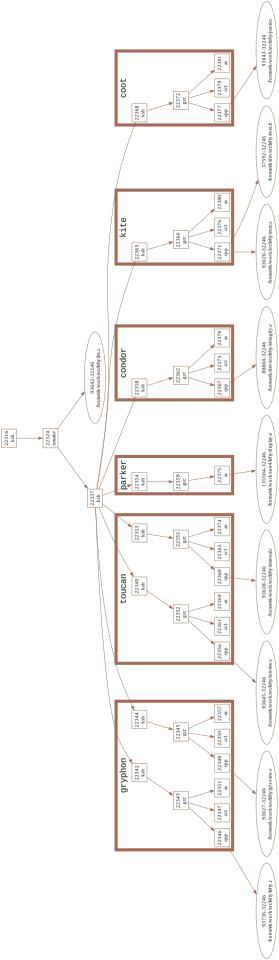
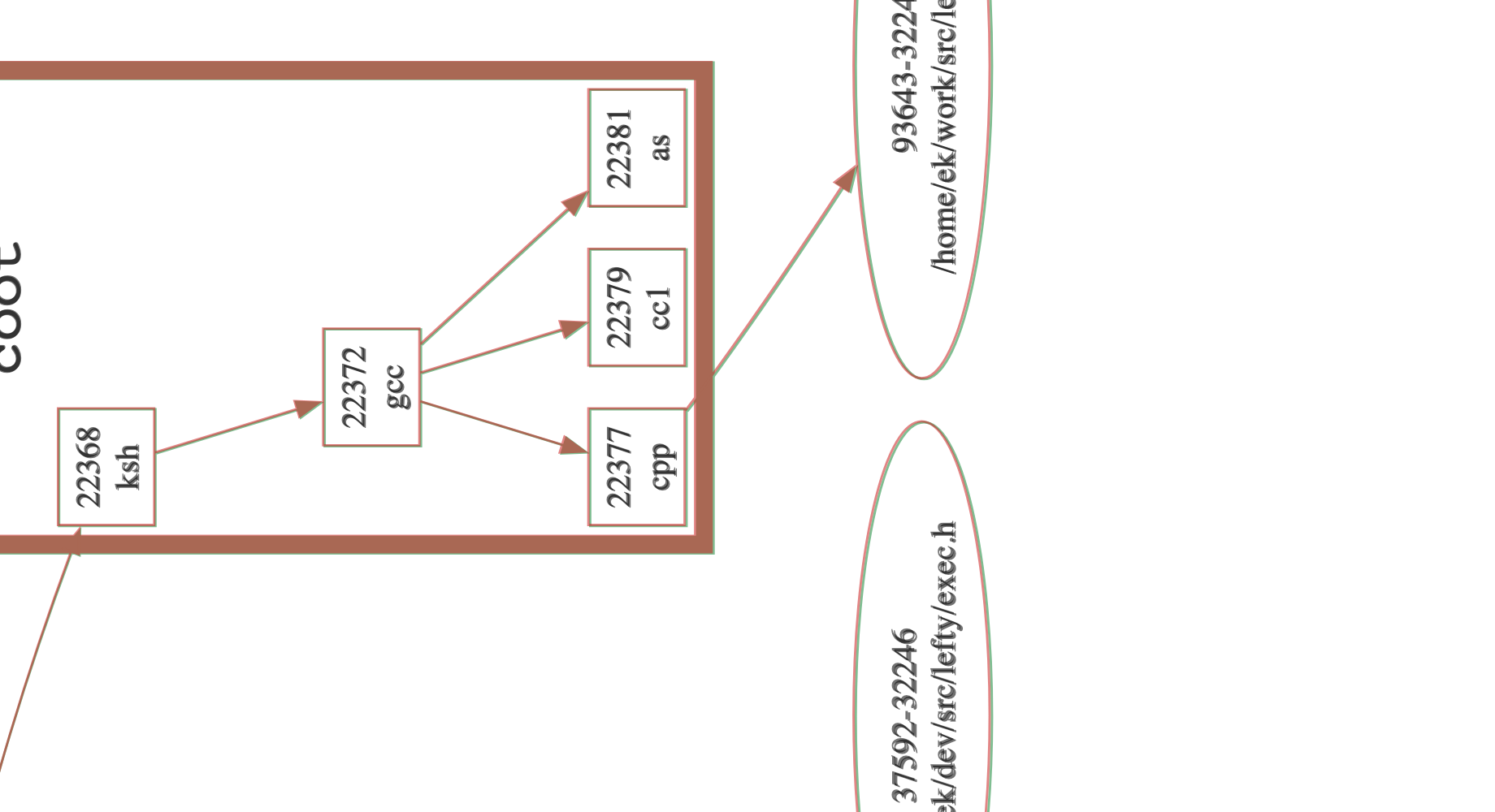
Zoomed in, the fringe appeared almost entirely on the long file-path oval labels:
Golden — native dot | Ours — graphviz-ts |
|---|---|
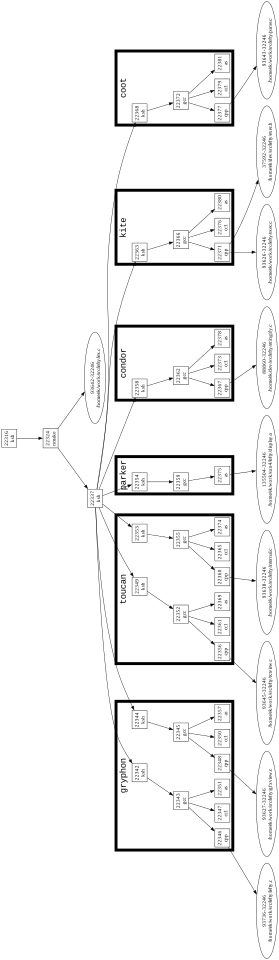 | 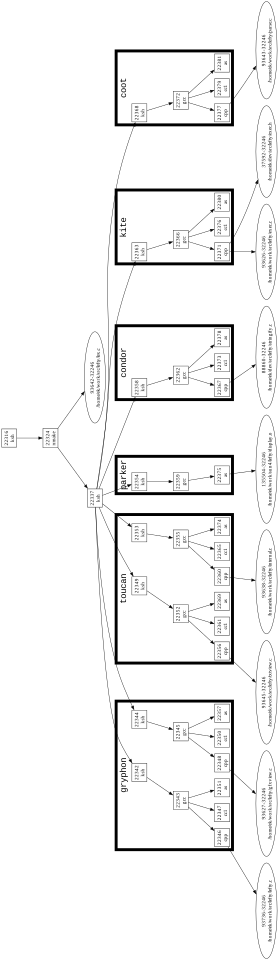 |
The standalone write-up (root cause, per-metric numbers, reproduce command) is on its own page: proc3d — the canonical A2 font-metric divergence (historical). That page describes a resolved divergence on a non-corpus input; the current corpus proc3d variants are conformant.
Why this was accepted at the time. Byte-matching FreeType's per-glyph advances across every font and string would have required replicating its metric tables, hinting, and rounding — large, fragile, and still not guaranteed exact. The text measurer is a shared primitive: every label in the corpus flows through it, so a fix aimed at one string risked regressing others for a sub-perceptual reward.
A3. hypot tie-break in spline routing (dot)
Affected: dot graphs with a geometrically symmetric edge-routing channel — typically a short, symmetric flat-edge arc. Observed example: 2368, which stays at structural-match (maxΔ ≈ 10.2 pt on one edge, 376->76). The same tie-break also surfaces on a long (multi-rank) edge into a high-fan-in hub when the corridor is exactly mirror-symmetric: graphs-b100 / graphs-b104 (identical source) diverge by maxΔ 20 (exactly one rank-row) on the single knot of Node23730->Node23729 — every node position and all upstream box/polygon/taut-path structure is byte-identical to C; only findMaxDev's ~1-ULP choice of which mirror-symmetric interior point becomes the bezier knot differs. The short flat-edge form also surfaces as 241_1 (structural-match, maxΔ ≈ 2.4 pt) — the divergent sibling of the oracle-pinned 241_0, which C's noise instead keeps-first. The same tie-break produces a labeled 2-cycle back-edge slit-corridor split in 2413_1 (structural-match, maxΔ 67.65) and 2413_2 (maxΔ ≤99.55 once the T11 swapBezier-reverse fix lands — until then the file's reported maxΔ 1922.26 is dominated by an unrelated, separately- tracked defect), and a single intra-cluster labeled edge in graphs-decorate (maxΔ 43.54); in each case the two candidate split corners tie to within 5.7e-13 (2413 family) / 3e-14 (decorate) of each other before the position-dependent Apple hypot noise picks a winner. 2371 (structural-match, maxΔ 16.8) shows the same fingerprint on two unrelated edges (g[9263] r6837mid--r9687mid, g[23859] r38mid--r8699mid): the port emits the exact control-point-sequence mirror of the oracle on both, knot y flipped by an identical Δ16.8 (top/bottom split fractions swapped). Its origin is qualified MEDIUM confidence rather than the CONFIRMED confidence of the other members: 2371 packs ~199 components, which decouples pathplan-local coordinates from page coordinates, so the tie could not be correlated live to route.ts:209 across three instrumentation attempts; a straight-mode-segmentation or post-clip recover_slack origin is not fully excluded. Full diagnosis: plans/residual-cleanup/analysis/2371-mirror.md. Most routed edges are unaffected.
Graph definition (2368.dot)
digraph G {
  compound=true;
  concentrate=true;
  node[shape=box,fontsize="8",color="#909090",height="0.1"];
  edge[style="dashed",fontsize="8",color="#808080",arrowsize="0.5"];
  line7[label="#7"];
  {rank=same; line7;136;}
  line7 -> 136[style=invis];
  line11[label="#11"];
  line7 -> line11[weight=100,style=invis];
  {rank=same; line11;16;}
  line11 -> 16[style=invis];
  line16[label="#16"];
  line11 -> line16[weight=100,style=invis];
  {rank=same; line16;76;376;256;196;436;316;}
  line16 -> 316[style=invis];
  316 -> 76[style=invis];
  76 -> 376[style=invis];
  376 -> 256[style=invis];
  256 -> 196[style=invis];
  196 -> 436[style=invis];
  76 -> 376[label="from1"];
  376 -> 76[label="to1"];
  16 -> 76[label="ignore"];
  196 -> 376[label="from2"];
  376 -> 196[label="to2"];
  136 -> 196[label="ignore"];
  256 -> 436[label="to2"];
  256 -> 376[label="to1"];
  256 -> 316[label="as"];
  436 -> 256[label="from2"];
  376 -> 256[label="from1"];
}
Characterization. The spline fitter (Proutespline → findMaxDev, src/pathplan/route.ts) splits a fitted bezier at the interior route point of maximum deviation. When the channel is symmetric, the two candidate split points are an exact mathematical tie, and the winner is then decided by ~1e-14 floating-point cancellation noise in an absolute-coordinate bezier evaluation whose sign depends on absolute position.
C's deviation distance is libm hypot, and the macOS Apple hypot that generated the oracle is a proprietary implementation that bit-matches no portable hypot (measured against it on the graphviz coordinate regime, bit- identical rates: V8 Math.hypot ≈ 63%, a correctly-rounded / Arm-style hypot ≈ 84%, fdlibm hypot ≈ 90%, sqrt(dx²+dy²) ≈ 94%). Because of that ULP noise C itself is not consistent: it splits two translation-congruent arcs toward opposite corners. Within 2368 the 376->76 arc is the mirror image of the geometrically identical 256->436 arc:
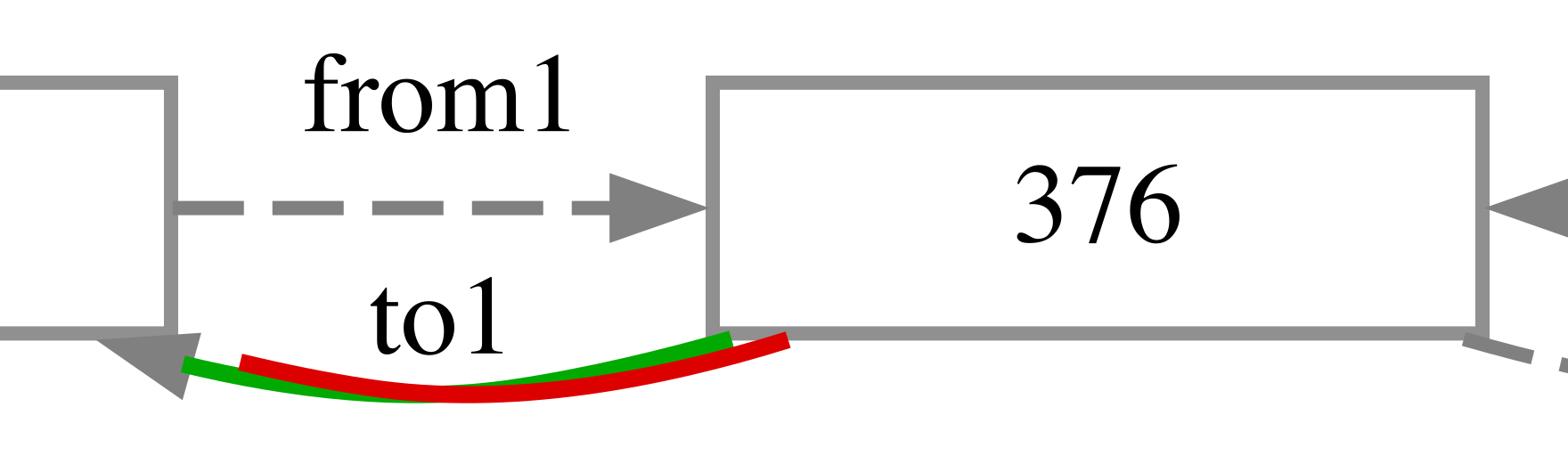
C    376->76 : M273.31,-4.56 C268.33,-3.14 263.11,-1.9  258.11,-1.15 250.49,0     242.34,-0.98 234.83,-2.8
port 376->76 : M277.29,-4.51 C268.27,-1.69 257.65,0.32  247.89,-1.15 244.92,-1.59 241.88,-2.21 238.85,-2.94
The entire delta, overlaid (12× zoom on the 376->76 / to1 arc) — green = C Graphviz, red = graphviz-ts. Both are the same shallow down-arc between the same node boundaries; they differ by ~1–2 pt at the belly (the mid bezier control point), where C's tie broke toward the opposite corner:
Everything else matches within tolerance — same bounding box (608×148), node positions, labels, arrowheads, and all other edges. The full renders are visually indistinguishable:
| C Graphviz | graphviz-ts |
|---|---|
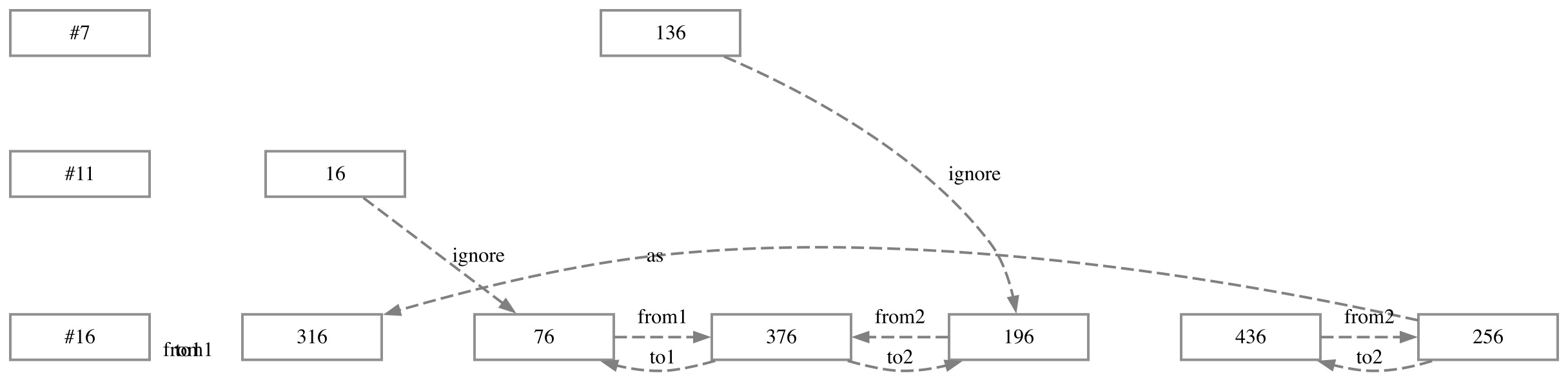 | 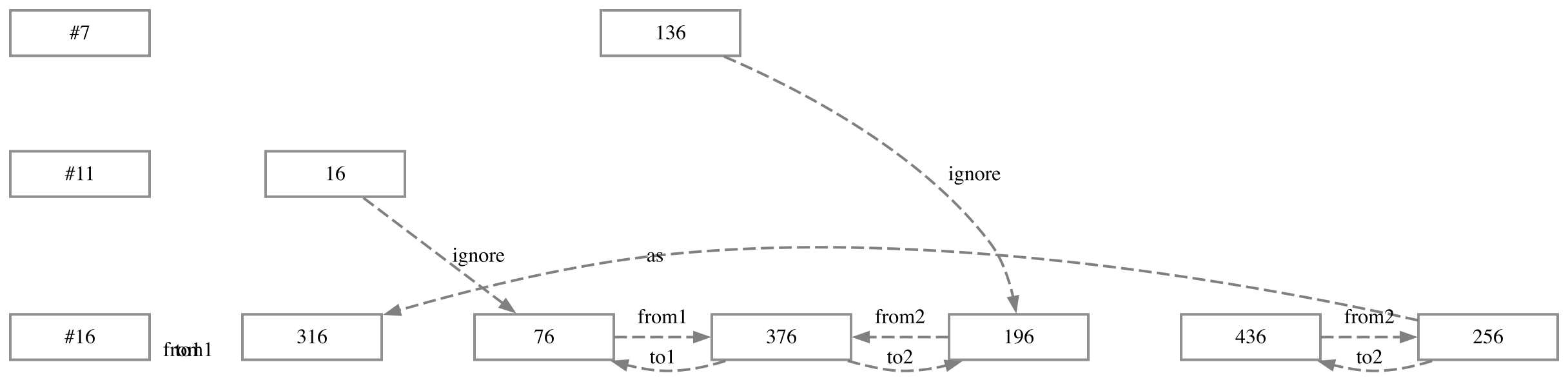 |
The port uses a translation-equivariant tie-break (a true tie always resolves to the first index), so it draws every such arc the same way regardless of position — it is self-consistent, and matches C on the arcs where C's noise also keeps-first (e.g. 256->436, and 241_0 5:ne->8:nw), diverging only where C's noise flips the other way (376->76). Endpoints, arrowhead target, the other edges, all nodes, labels, and the bounding box match within tolerance; only the interior control points of the one arc move (~1–2 pt at the belly).
Why accepted. Apple's hypot is no more reproducible across JS engines and CPUs than the FMA/pow of A1 — it is the same portability constraint, just in the dot spline router. Matching C's position-dependent choice would mean adopting C's strict tie-break, which lives in a shared primitive every routed edge flows through: doing so trades the 376->76 match for new mismatches on the arcs where C lands the other way (it regresses 241_0 and a cnt=3 flat-edge oracle case), a net wash that also sacrifices the port's translation-equivariance. So we keep the consistent (equivariant) router. This is a bounded, sub-perceptual dot delta — not an open bug. Full investigation: .agent-notes/2368-residual-flat-label-ranksep.md.
A4. Oracle in an acknowledged-broken state (the init_rank / pathplan family)
Affected: 2796 (structural-match, maxΔ 49), 2471 (structural-match, maxΔ ~9063), 2470 (structural-match, maxΔ 8), 1435 (diverged, maxΔ 503), graphs-structs (diverged, maxΔ 0), 1581 (diverged, maxΔ 465). Family members 1939 and 2825 are conformant and carry no entry. 2470 is the sibling of 2471 (same triangulation-debris recovery); the port loses the identical edges.
1581 and 2825 were crash-recovery cases (fix-element-count-bucket mission): fuzzer/degenerate inputs where the upstream tests assert only that dot does not crash (test_1581: no ASan violation; test_2825: no crash when rebuild_vlists returns -1). C hits an internal Error: (install_in_rank / rebuild_vlists: lead is null) and its recovery discards layout content; the port reaches the identical rankset-deletion decisions (warning parity verified: the same node/graph names in mark_clusters' "already in a rankset" warnings, cluster.c:317-320).
2825 is now fully closed. The fix-2825-rebuild-vlists mission (post-1581) first closed the gap one layer: the port reaches C's exact internal-error state — byte-identical stderr including message order (Error: rebuild_vlists: lead is null for rank 1 then the unprefixed agerr(AGPREV, ...) continuation concentrate=true may not work correctly.) — with dotLayoutPipeline correctly propagating dot_position's failure to skip dot_splines/dotneato_postprocess, matching C's dotLayout (if (r != 0) return r; after dot_position, dotinit.c:322-325). A follow-up (part 2) then closed the remaining render-layer gap: C's emit_node gates every node on node_in_box(n, job->clip) (emit.c:1806-1809), and on this abort path job->clip is degenerate because GD_bb was never set by set_aspect (inside the skipped dot_position tail) — so C emits zero nodes, only the (also degenerate) cluster frames. The port ported that same node_in_box gate (src/gvc/device.ts:renderNode, using job.bb/job.pad as the single-page-equivalent of job->clip) and stopped recomputing a plausible bbox from live node positions when g.info.bb is unset (src/gvc/device.ts:render, job.bb = g.info.bb verbatim, mirroring init_gvc's gvc->bb = GD_bb(g), emit.c:3272) — every layout engine already sets g.info.bb itself before render() runs on every non-abort path, so this is byte-identical on healthy graphs and only changes output on this abort path. 2825 is now conformant (4-element output, byte-identical to the oracle). See .agent-notes/2825-rebuild-vlists-abort.md for the full mechanism trace of both parts. 1581 never reaches the inconsistent state at all (a different upstream cluster-window bug, not rebuild_vlists), so it lays out its surviving graph in full — that gap remains open. The oracle output on 1581 is recovery debris with no upstream-defined semantics. Evidence: 1581. On every one of these inputs it is the C oracle that is broken, by graphviz's own account: 2471, 1939 and 1435 are xfail(strict=True) upstream (issues #2471, #1939, #1435, cf. #2796); the only fix attempt, draft MR !4849, remains an unmerged draft (last edited 2026-03-20). graphs-structs is the ancient record-routing loss class (#102/#242/#274/#1323) that stable graphviz 15.0.0 renders correctly — a dev-build oracle regression.
What C does. On the init_rank members (2796, 2471, 1939), native dot's x-coordinate auxiliary graph closes a directed cycle through cluster wall-constraint edges; its init_rank cannot scan every node, prints Error: trouble in init_rank, and the layout proceeds from that recovery state — on 2471/2796 ending in Pshortestpath triangulation debris and lost edges. On 1435 and graphs-structs the broken stage is pathplan itself (ear-clip triangulation dead ends; a lost record-port edge).
Inputs verified, then made faithful (this is the load-bearing part). The verify-oracle-bug-family mission (brief) dumped the constraint graph both sides feed network simplex, line-by-line, for every family member — and found the port's earlier "clean" behavior on this family came from four genuine port defects, all fixed:
flatEdgesskipped C'srec_reset_vlistscall, leaving cluster rank windows stale after flat-label vnode insertion (this alone made the port lose 9 edges on2471where C loses 6).- The same-
groupedge penalty fired on self-loops instead of same-non-empty-group endpoints (dot_init_edge). CL_CROSSused C's_WIN32value 100; the oracle platform uses 1000 (const.h).- A triangulation dead end aborted
Pshortestpathinstead of C's warn-and-continue + straight-line fallback (shortest.c:333).
Post-fix, the family's NS constraint dumps are line-identical to C (253 rank2 calls on 2471; all calls on 1939/1435/graphs-structs), and the port follows C through the acknowledged-broken recovery: same lost edges (3->16 on 2796; the identical 6 on 2471), same element trees. 1939 became fully conformant. The residual numeric deltas (and 1435's differing pathplan debris) are behavior inside the recovery state, which project policy deliberately does not chase.
Policy note. The earlier A4 stance ("the port meets the issue's expectations; do not replicate") was based on the belief that the port's acyclic aux graph came from a benign local variant. It did not — it came from defect (1), which demonstrably mislaid 2471. Faithfulness to the C source won: the port now reproduces C's acknowledged-broken outcomes from verified-identical inputs, and every entry here should be re-measured when upstream fixes the corresponding issue (the oracle output will change; expect these ids to light up as regressions at that upgrade — that is by design, not rot).
Evidence. Per-id comparison pages (side-by-side renders + evidence records): 2471, 1939, 1435, graphs-structs, 2796 post-fix addendum (pre-fix baseline preserved at 2796-cluster-ranking.md). Diagnosis artifacts: .agent-notes/2471-stale-cluster-windows-missing-reset.md, .agent-notes/1939-group-penalty-clcross-misports.md.
A5. Invalid input bytes (encoding representation)
Affected: 1367 (diverged, maxΔ 0 — exactly one structural diff).
What differs. The input file contains a naked UTF-8 trail byte (0x80) inside a node name. C treats naked trail bytes 0x80–0xBF as "valid characters representing themselves" (lib/common/utils.c:1200-1207, no warning), and node-name <title> text bypasses charset conversion entirely (agnameof bytes flow straight to gvputs_xml). The oracle SVG therefore contains the raw byte and is not valid UTF-8 despite its declared encoding. The port decodes invalid-UTF-8 input with the latin1 fallback (0x80 → U+0080) and emits well-formed UTF-8 (\xc2\x80).
Why accepted. The port's I/O boundary is JS strings (browser library). A raw invalid byte cannot round-trip through renderSvg's string return value; byte-matching C would mean corrupting the output encoding for every consumer. The latin1 fallback mirrors C's own "treated as Latin-1" recovery semantics (utils.c:1249). This is a constraint below the code — the representation layer — not a portable behavior we declined to port. Everything else in 1367 is conformant: element counts (23 polyline / 103 text / 44 polygon / 24 path) and all coordinates match after the decorate (T6) fix.
Evidence.1367 comparison page (side-by-side render + evidence record).
A6. unsigned int canvas overflow on degenerate input
Affected: 1314 — a fuzzer-derived input (fontsize="991836031967s8") whose absurd font size balloons the drawing to ~2.75e11 pt.
What happens. C stores job->width / job->height as unsigned int (gvcjob.h:327-328). The ROUND(...) of the huge point size (emit.c:1249-1250) overflows 32 bits and wraps mod 2³², and the SVG backend emits it through a signed %d (gvrender_core_svg.c:258-259) — so C prints height="-425618343". The port keeps the mathematically-consistent (unwrapped) value. Every other value — node ellipse cx/cy/rx/ry, the root translate, the polygon, the text font-size — is byte-identical; only the top-level <svg> width/height differ.
Why we don't chase it. Replicating C's 32-bit integer overflow is not a layout behavior worth porting, and the input is degenerate. Revisit if upstream fixes the overflow (e.g. widens the field or clamps the size).
A7. round() box-wall rounding boundary (dot)
Affected: graphs-honda-tokoro (structural-match, maxΔ ≈ 1 pt on the single edge n012->n011).
What differs. maximal_bbox's head-corridor box wall lands at internal x=90 in C versus x=89 in the port for the shared samehead port of the two n012->n011 parallels. The shared-port construction (buildSharedPort) and the parallel grouping are both byte-conformant to C; the 1 px gap is purely a round() rounding-boundary artifact — ~1e-14 of upstream floating-point noise tips a value sitting exactly on a .5 boundary to the neighbouring integer. The port's maximal_bbox formula already mirrors C's exactly.
Why we don't chase it. round() is a primitive every routed edge in the corpus flows through; nudging its boundary behaviour to match this one case is a corpus-wide regression risk for 1 px on 2 edges — the same shared-primitive constraint as the control-hull rounding noted in bbox-class-control-hull-vs-curve. Full diagnosis: .agent-notes/honda-samehead-shared-port.md.
A8. fp-contract/FMA rounding vs. strict IEEE (dot)
Class. clang arm64 compiles the oracle binary with -ffp-contract=on, fusing selected multiply-add sequences into single FMA instructions; the port runs on V8, which performs strict IEEE-754 rounding and cannot emit fma. On bit-identical inputs the two disagree by 1-2 ULP at whichever expression the compiler chose to contract. The port side is always the strict-IEEE-754 result; the oracle side is always the FMA-contracted result. This is a compiler/runtime portability constraint below C source-code semantics, not a logic defect in the port — irreducible without emulating clang's specific contraction choices in software. Two instances are known, at two different sites, with two different amplification mechanisms:
- 2646 — the ULP arises inside
Proutespline'spoints2coeff/solve3cubic solve and directly flips a spline-fitter root count. - 2620 — the ULP arises in
poly_init's polygon vertex-extent loop (node sizing) and is amplified downstream byortho's faithful per-relax int-truncation into an equal-cost maze-corridor tie flip.
Affected: 2646 (structural-match, maxΔ 42.09 on 3 of 21,216 edges: edge2575 g[4639], edge3905 g[7777], edge15467 g[30201] — all record-port :c->:nb_part smode long-edge routes). Sibling of A3: both classes are irreducible floating-point-portability ties inside Proutespline, but the mechanism is distinct — a compiler fp-contract artifact, not libm hypot.
What differs. On all three edges, only the final routesplines call (a straight leg into the head port) diverges. Its endpoint lies bit-exactly on the barrier polygon's bottom wall with its tangent parallel to that wall (evs[1]=(1,-1.22e-16)), so every splinefits candidate is tangent to the barrier at t=1 — a near-double root of the intersection cubic. points2coeff computes that cubic through catastrophic cancellation (terms around ~7446 collapsing to ~0.099). The oracle (clang/arm64, -ffp-contract=on) contracts v3 + 3*v1 - (v0 + 3*v2) into fused multiply-adds, while V8 performs strict IEEE rounding — the two disagree by ~9.1e-13 on bit-identical inputs, and that noise flips the sign of the solve3 discriminant: C finds 1 root (866.7, inside the segment); the port finds 3 roots with a spurious partner root at t=0.9999975 < 1-EPSILON2. The spurious root triggers one extra a-halving iteration, which flips the final piece's tangent magnitude by a factor of 2 (in either direction across the 3 edges), producing the maxΔ 42.09 post-clip (26 SVG diffs).
Why accepted (irreducibility proven by a controlled experiment). All six routesplines calls were dumped on both sides — box, polygon, PL, start, end, and evs are byte-identical, as is the earlier (non-final) call's output spline; the only divergence is inside the final call's solve3. A standalone pristine-C harness isolated the single variable: compiling with -ffp-contract=off reproduces the port bit-exactly on all 3 edges; the default (on) contraction reproduces the oracle bit-exactly on all 3 edges. The port therefore already agrees with strict-IEEE-754 C; the divergence is entirely the oracle compiler's FMA contraction choice, below C source-code semantics — there is no source-level infidelity to fix. A targeted fix (hand-emulating the contraction in points2coeff) was tried and refuted: it corrects 2 of the 3 edges but not the third, whose flip originates inside solve3's own internal contraction. A complete fix would require software-FMA emulation across the whole spline fitter — a hot-loop cost with corpus-wide rounding blast radius for a sub-pixel, 3-edge reward. Full diagnosis: plans/residual-cleanup/analysis/2646-fp-contract.md.
Affected: 2620 (structural-match, maxΔ 585; 423 diffs on 24 edge paths
- 22 arrowheads).
What differs. The ortho (splines=ortho) pipeline is byte-conformant to C given identical inputs — proven by injecting C's exact maze input (coordinates, xsize/ysize) into the port's ortho stage: 378/378 routed segments come out byte-identical, so nothing in src/ortho is at fault. The actual divergence is 1-2 ULP in the maze input: node ysize (and, by within-rank accumulation, ND_coord.y) computed in C's poly_init polygon vertex-extent loop (shapes.c), which under -ffp-contract=on fuses R.x += sidelength*cosx into an FMA that is ~1 ULP larger than the port's strict-IEEE arithmetic (both sides implement the arithmetically identical expression). 2620 has 173 fractional-width polygon nodes; all show C ≥ port by 1-2 ULP. That ULP is amplified — not introduced — by ortho's Dijkstra relax, which faithfully truncates its running distance per-step (sgraph.c:165, mirrored by the port as Math.trunc) over weights derived from raw cell extents (maze.c:257). The ULP-shifted geometry flips an equal-cost corridor tie for 4 routed edges (paths + their arrowheads); the remaining diffs are ±1-track renumbering knock-on from those 4 flips.
Why accepted (irreducibility proven by a controlled experiment). A standalone C harness varying only -ffp-contract reproduced both sides on the divergent hexagon vertex: -ffp-contract=on → 310.29250168188713 (matches the oracle), -ffp-contract=off → 310.29250168188707 (matches the port), with the divergent operation isolated to vertex i=3 (R.x=-0.50000000000000011 fused vs. -0.5 unfused). A second input-injection experiment (only variable: ortho input values) confirmed the amplifier: feeding the port's own orthoEdges C's exact coord/xsize/ysize collapses all 4 corridor divergences to 0 — the ortho code has no defect, it is just sensitive (as C's own maze-cost routing is) to a 1-2 ULP shift in its input. Matching would mean emulating clang's specific FMA contraction of one compiled expression tree in poly_init — chasing a compiled artifact, not porting source semantics. Full diagnosis: plans/ortho-2620-residual/analysis/2620-ortho-route.md.
Tracked long tail (dot attribute & edge-case)
At defaults, the dot engine matches the C binary to a tight deterministic tolerance on the golden corpus (the conformant verdict; see the note at the top). The remaining differences are the long tail of attributes and edge cases — the historically hard part of any Graphviz port. Unlike the accepted deltas above, these will be closed; they are tracked live, with counts, in PARITY.md:
| Category | What differs |
|---|---|
| path-structure | Edge spline routing in specific configurations (e.g. some flat-edge and dense-corridor cases). |
| element-count | A feature that emits extra/fewer SVG elements than C in certain graphs. |
| color-stroke | Stroke/fill emission differences for specific style attributes. |
| parser-gap | A small number of DOT inputs the parser does not yet fully accept. |
If your graph uses only common attributes and the dot engine, you are almost certainly on the deterministic-tolerance match path. If a layout looks wrong, check PARITY.md for that input class — it is likely a tracked item with an oracle-pinned fix mission, not an unknown.
Note on label-driven cases. The text-measurement class (A2) is closed — no
dotgraph is accepted under it any more. A graph that sits at structural-match today is a tracked gap, not a font-metric delta.
concentrate=true opposing-edge arrowheads
When concentrate=true merges an anti-parallel pair (A->B; B->A) into one surviving edge, that edge must draw an arrowhead at both ends. This is now ported (the conc_opp_flag branch of arrow_flags; see src/common/splines-clip.ts:arrowFlags), so graphs-b135, 167, and 2087 match (the missing-arrowhead element-count divergence and its unclipped-spline @d side effect are both gone).
Some concentrate graphs retain a separate, pre-existing residual that the arrowhead fix does not address — it is a node x-coordinate position delta (x-network-simplex / compass-port), not an arrowhead defect:
graphs-b15,graphs-b69— the large record/cluster "elevator" graphs. Concentrate activates and merges correctly; the residual is a ~1pt node-x delta that amplifies into anelement-count/spline@ddifference. The arrowhead emission itself is now correct (b69 gains its missing arrowhead polygons). See theb69-concentrate-undermergeagent note for the x-coord root cause.1453— still diverges on a top-levelelement-countcause unrelated to the conc_opp_flag arrowhead.2825— at the time of this arrowhead fix, diverged on a top-levelelement-countcause unrelated to conc_opp_flag (no opposing-pair merge is triggered there); since closed by the fix-2825-rebuild-vlists mission, see A4 above.
These are tracked x-coordinate / structural items, not arrowhead bugs.
Intentionally not ported (non-goals)
These are deliberate scope boundaries, not bugs. The library targets SVG (plus the json / xdot / dot / imagemap intermediate text formats).
- Other output formats. Raster (PNG/JPG/GIF/WebP/BMP), PostScript/PDF/EPS, and GUI/interactive backends are out of scope. Use the SVG output and convert downstream if you need a raster.
page=pagination for SVG. Nativedotdoes not paginate SVG either (the SVG device sets no pagination flag), sopage=is a no-op on this path in both implementations — documented here only because it is a common point of confusion.-Tplaintext output. Deferred (a faithful text format), not excluded.gvpr(the graph-processing scripting language) — out of scope.- C++ convenience wrappers (
cgraph++,gvc++) — the C API is ported first; an idiomatic-TypeScript convenience layer, if wanted, would be a separate package. - Native-only mechanics replaced by browser-safe equivalents: dynamic plugin loading (
dlopen) is replaced by static engine/renderer registration; filesystem reads (fonts, images, config) are replaced by caller-supplied callbacks (e.g.setImageSizer). Behavior is preserved; the mechanism differs.
Reporting a divergence
If you find output that differs from C and is not an accepted delta above, not in PARITY.md, and not a non-goal, that is a bug worth reporting — the C source is the spec, and unlisted divergences are treated as defects, not accepted behavior.